

Wishes for change related to well-being are common: less stress, better recovery, a more functional everyday life. Yet many people find themselves repeating the same behavioural patterns, even when they no longer support their well-being. This is not a lack of willpower – it is about habits.
Why is changing habits difficult?
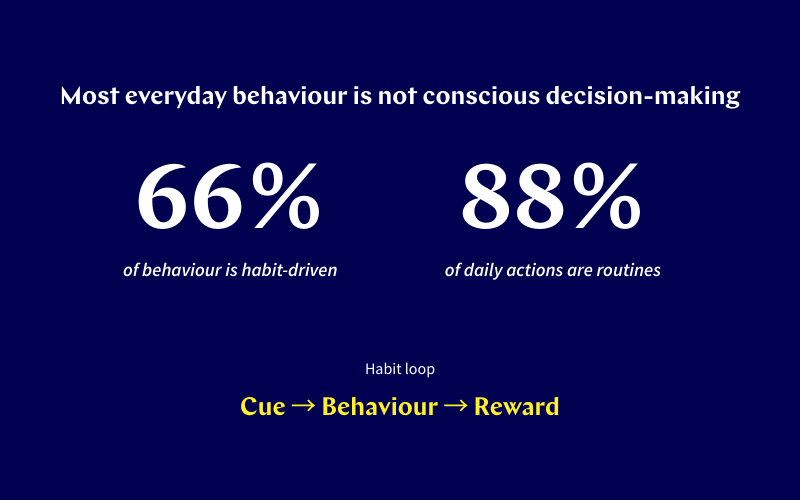
With sufficient repetition, habits become automated. They turn into behavioural patterns that are activated in specific contexts, often triggered by environmental cues, emotional states, or situations – without us noticing. The power of habit becomes especially visible under stress or overload. In such moments, we default to what is most deeply rooted – even if it does not support our well-being.
Common barriers to behaviour change include:
-
Strong neural embedding of old patterns – a new habit does not erase the old one.
-
Goals that are too broad or vague – “I will live healthier” does not provide the brain with a clear behavioural script.
-
Ongoing busyness and stress – under fatigue, the brain conserves energy and prefers the familiar. Learning a new habit requires effort, and capacity is limited under strain.
-
Change driven by external pressure rather than personal values – when change does not feel meaningful, it relies solely on willpower. And willpower is a limited resource.
Sustainable behaviour change becomes easier when we understand what need the old habit has served and how it can be replaced with a more functional alternative.
Lasting change is built on small, repeated actions
Research shows that new habits form most effectively when they are:
-
small and concrete
-
easy to implement in daily life
-
connected to existing routines
Habit formation takes time. On average, it requires several months, and progress is rarely linear. Setbacks are not failures, but a normal part of the learning process. What matters most is:
-
focusing on consistency rather than perfection
-
recognising progress along the way
-
practising self-compassion
Meaning matters – not just willpower
Lasting change is not about tightening self-discipline. It emerges when a new behaviour connects with personal values and identity: the kind of person one wants to be and the kind of everyday life one wants to live. Change that lasts does not feel like fighting yourself. It feels more like cooperating with yourself.
Support for behaviour change in everyday life
Change does not have to be built alone. Research-based guidance, structure, and space for reflection help make habits visible and support the development of more sustainable behavioural patterns. In Auntie’s discussion packages, a trained professional supports you step by step in everyday change, for example:
Overachiever – support in reducing perfectionism and excessive self-pressure
Bounce Back – strengthening recovery and resilience
Leading Me – tools for self-leadership and managing everyday demands
Small, repeated actions beat big promises.
If you recognise yourself in these themes, Auntie’s services may be a meaningful next step toward a more sustainable everyday life. Auntie is a service employers offer to their employees. Learn more here.
Share article


Writer: